SBS & JIBS National Television Broadcast: Marine Bio-Waste Transformed into Advanced Electronics

SBS & JIBS National Evening News Feature Broadcast
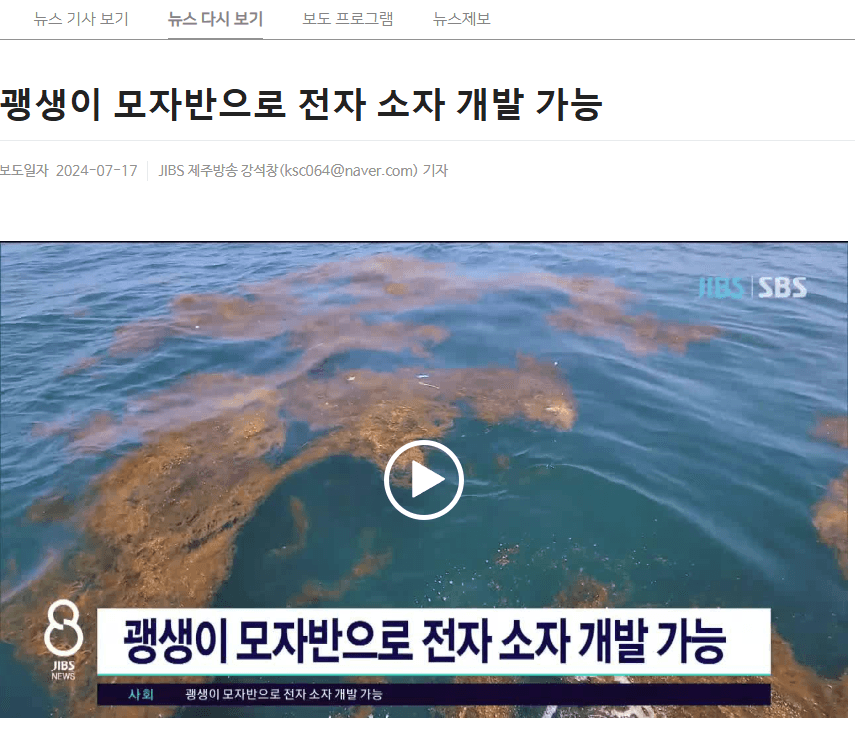
Broadcast Notice: This national television investigative report originally aired on the SBS and JIBS network evening news in South Korea. The complete video broadcast is available in the SRE² Lab Visual Gallery.
National Television Spotlight on SRE² Sustainable Innovation
South Korea's leading national broadcasting networks SBS and JIBS featured a special investigative science report highlighting groundbreaking research led by Dr. Qazi Muhammad Saqib and collaborating researchers at the Ocean Integrated Smart Engineering (OISE) Laboratory and SRE² Lab.
The broadcast, titled "괭생이 모자반으로 전자 소자 개발 가능" (Electronic Devices Can Be Developed Using Sargassum horneri), demonstrated how invasive seaweed washed ashore on coastal coastlines can be upcycled into high-performance functional electronic materials.
The Environmental Challenge: Marine Inundation to Clean Energy
Every year, thousands of tons of Sargassum horneri (brown marine alga) drift across East Asian coastlines, creating critical environmental and economic damage to coastal fisheries, tourism, and marine habitats. Traditional management involved costly disposal, landfill accumulation, and significant carbon footprint.
Under this pioneering initiative, the research team engineered an advanced thermochemical reactivation and surface functionalization method to extract biopolymeric components and porous conductive matrices from the discarded seaweed.
Key Technological Breakthroughs:
- Bio-Derived Tribopositive Layer: Utilizing natural polysaccharides from marine biomass to maximize surface electron donor capabilities in triboelectric nanogenerators (TENGs).
- Multitasking Electrochemical Performance: Achieving exceptional charge density for active tactile sensing, pressure monitoring, and biomechanical energy scavenging.
- Circular Economy in Materials Science: Fully closing the loop by converting environmental pollutants into clean, zero-carbon self-powered electronic platforms.
Published in Leading International Journal
This nationally broadcasted scientific achievement is documented in full detail in the peer-reviewed journal Nano Today (Impact Factor: 13.2):
"Unveiling the marine Sargassum horneri material for energy and active sensor devices: Towards multitasking approaches"
Nano Today, Vol. 57, 102379 (2024).
Authors: S. R. Patil, M. Noman, R. Kulkarni, C. S. Patil, Qazi Muhammad Saqib, M. Y. Chougale, J. Kim, Y. Ko, Y. P. Jeon, T. D. Dongale, and J. Bae.
The SRE² Lab continues to expand on this sustainable materials platform, developing scalable zero-waste fabrication processes for aerospace, healthcare wearable electronics, and self-powered IoT marine sensors.